Biography
Fadime Baltacıoğlu: The Painter of Line, Rhythmic Dynamism, and Originality
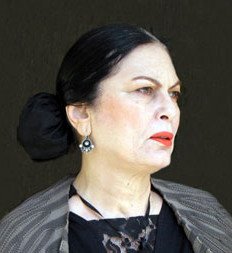
Known in Turkish painting for her solid structural drawing, unstoppable rhythmic dynamism, and her unique "capillary textured linear style," Fadime Baltacıoğlu is a peerless talent who sees her art entirely as a process of "creation and composition."
1. Identity, Family, and Childhood Years
Fadime Baltacıoğlu was born in Ankara on September 2, 1946. Married to Kadir Salman, the artist has two children from this marriage named Ilgın (1974) and Tarık (1977).
The role of her family and the intellectual environment in which she grew up cannot be denied in the formation of Fadime's artistic identity. Her mother is Samime Hanım, and her father is Ord. Prof. İsmayıl Hakkı Baltacıoğlu, one of the most important intellectuals of the Republican era. Her father was the first rector of the Republic, a member of parliament between 1943-1950, and the founder and writer of the Yeni Adam newspaper. He is also a pedagogue, sociologist, and philosopher who created the "Productive Education" theory that formed the basis of the Village Institutes. The fact that all family elders were acquainted with Atatürk shows the close bond of the Baltacıoğlu family with the founding cadres of the Republic.
Fadime took her first painting lessons at a young age from her father, who previously taught Aesthetics and the Method of Painting at the Sanayi-i Nefise Mektebi (School of Fine Arts).
2. Educational Life and the Discovery of Her Talent
Starting her education life at Bahçelievler Primary School, Fadime subsequently studied at Bahçelievler Secondary School, Cumhuriyet High School, and Çamlıca Girls' High School. At the same time, she received education at the Fenmen Ballet School, Turkey's first ballet school, between 1958-1962.
During her primary school years, she displayed a very different perception and adaptation skill compared to her peers. One day, when her teacher placed a chair on the rostrum in the middle of the classroom and asked the students to draw it, Fadime was the only person in the class whose drawing resembled a chair. Her friends were amazed to tell that in her drawing, both "the bottom and all four legs" of the chair were visible at the same time.
Although getting a failing grade in her painting class while at Bahçelievler Secondary School distanced her from painting for a short time, the next year, the teaching style of her teacher Ömer Hatipoğlu, who made students do studies from nature, reignited the passion inside her. Fadime's hand studies caught Hatipoğlu's attention so much that he gave her father the good news that his daughter would become a great painter in the future (Father Baltacıoğlu was already aware of this fact). As a matter of fact, when Fadime opened her third exhibition in 1965, her teacher Ömer Hatipoğlu would write the following historical note in the guest book: "I strongly believe that Fadime will carve out a unique place for herself in Turkish painting in the future."
3. "Wunderkind" and the Paris Opportunity
In the early 1960s, under the leadership of Nihat Adil Erkman, the Undersecretary of the Ministry of National Education at the time, Fadime's outstanding talent was noticed. Within the scope of the "Wunderkind Law" (or İdil Biret Law), with the rights granted to specially gifted children, it was brought to the agenda that she be sent to Paris by the state for 4 years (1962). However, since it was not possible for her father Baltacıoğlu to accompany his daughter at that time, this proposal did not materialize. Her father was of the opinion that, "One can educate oneself in the environment of Turkey as well; however, to increase knowledge, culture, and manners, it is necessary to go to Europe and visit museums."
4. Mahmut Cûda Period and Academic Foundations
Father İsmayıl Hakkı Baltacıoğlu would host teachers and artists such as Celâl Esad Arseven, Mahmut Cûda, Hikmet Onat, Zeki Faik İzer, and Sabri F. Berkel at his home in Çamlıca, and consult with them over Fadime's paintings lined up on the wall. Overhearing these conversations deeply affected Fadime's working discipline.
Her father chose Mahmut Cûda among this distinguished group as a teacher for Fadime. Between 1961-1964, Fadime entered a rigorous academic education process by attending the "Free Art Courses" opened by Cûda with Master Architect Fazıl Aysu in Osmanbey.
- Versatile Education: During this process, she not only did nude studies; she also took classes in descriptive geometry, perspective, anatomy, French, history of Turkish and European art, contemporary art, and mythology.
- Meeting with Clay: Between 1961-1963, she became acquainted with clay. By making children's heads, hand-foot studies, and plant reliefs, she learned to grasp forms with her hands.
Mahmut Cûda frequently warned his student that she should work "with her eyes, not with her hands." Determining the proportions of objects to each other and establishing the part-whole relationship became Fadime's most fundamental plastic concern.
The Golden Ratio and "Sorrowful Women" (1962): Fadime worked continuously under Cûda's supervision, sketching even during rest hours. Her teacher admired this passion of hers but would not immediately show his appreciation so that she would not be "spoiled." However, when Fadime made her first composition named "Sorrowful Women" (100x70 cm) with charcoal in 1962, Cûda was astonished. Even though he had not yet taught his student the geometry system of the classics and the "golden ratio" (séction d'or) technique, Fadime had found and applied this system herself through intuition. Cûda expressed to father Baltacıoğlu with great pride that "If it were necessary to discover a wunderkind, it would be none other than Fadime."
5. Art Philosophy: Composing, Not Executing
For Fadime Baltacıoğlu, who said "I would rather compose a work than execute it" while still in high school, painting is entirely an act of "creation." It is neither copying nature completely nor breaking away from it entirely; for her, art is the integration of the abstract and the concrete.
She summarizes her philosophy in her 1996 exhibition brochure as follows:
"I believe I have reached the rules of beauty through accumulation and the power of intuition. I learned everything, including composition, reflection, chiaroscuro, penumbra, color perspective, descriptive geometry, harmony, and anatomy. However, when I sat in front of the canvas, I did not think about any of these. I only listened to the voice inside me. That voice always told me what I needed to do."
She is an artist who, upon taking the brush in her hand, sets aside all the rules and techniques she has learned and draws instinctively, "the way she wants it to be seen."
6. Drawing, Line, and the "Capillary Textured Linear Style"
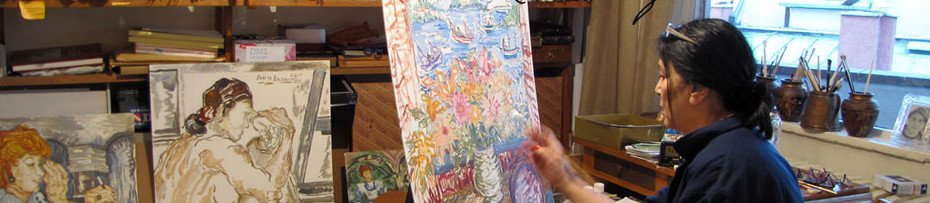
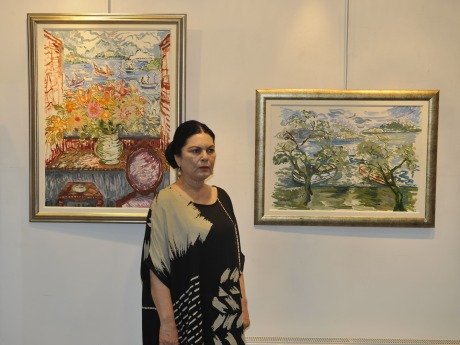
The backbone, origin, and essence of Fadime Baltacıoğlu's art is the line (drawing). Whether in oil or watercolor, the entirety of her paintings derives its soul from the line. She signs works that justify Degas' statement, "Drawing is the interpretation of form and nature," and Ingres' saying, "Drawing is the honor and abundance of art." No object is seen exactly as it is in her works; she depicts "living still lifes" with squirming, thin-thick lines. A flat, haphazardly painted background is almost never encountered in her works. She bends and reconciles colors and light; the color and shape harmony in the paintings makes sudden, high-acceleration turns while gliding from figurative to non-figurative.
Capillary Textured Linear Style: This technique, which is her unique and most well-known style, was born from an accidental observation. Seeing the arms of a male customer at an adjacent table in a cafe she was sitting at with a friend, covered with curly hairs, inspired her to design this original texture (She used this technique masterfully in her 1971 work 'Yusuf and Zeliha'). Furthermore, the artist has developed a special style on "figures in a single body," which she has not yet exhibited.
The special depiction of muscular arms, hands, and legs in the artist's compositions is her most distinguishing signature.
7. Preferring the Difficult: Murals and the War of Independence Epic
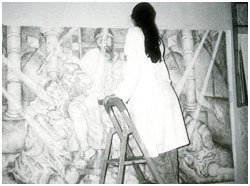
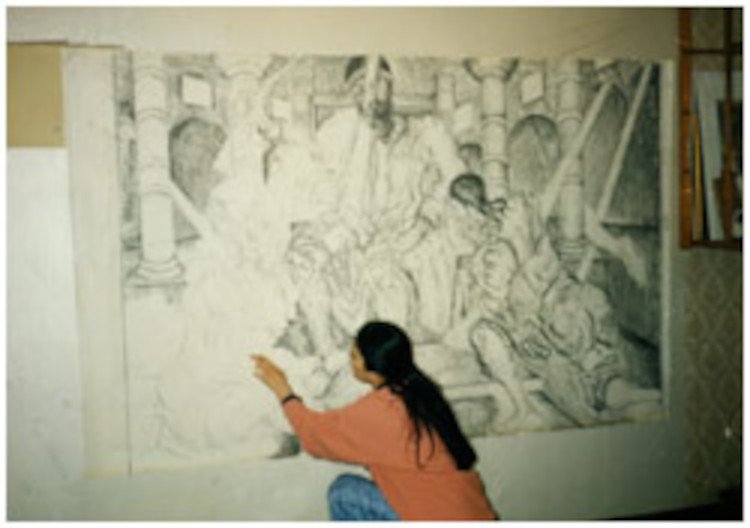
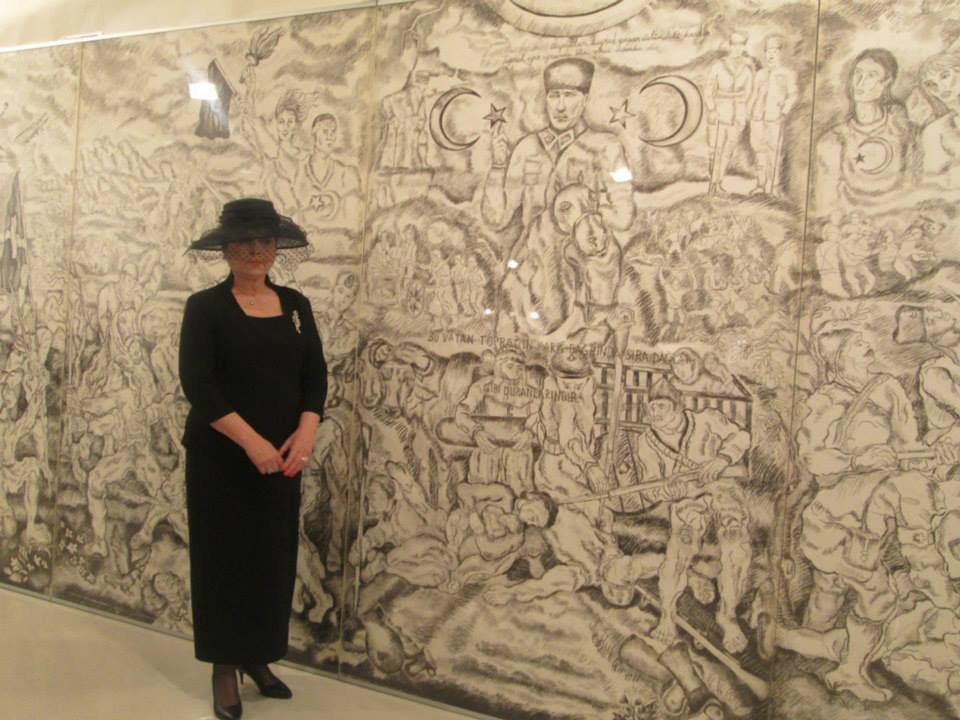
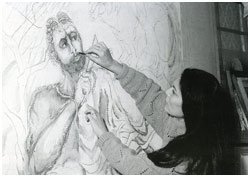
Fadime Baltacıoğlu is an artist who loves challenges, not content with the comfort of working on a table or an easel. While working in dimensions of 1x0.70 meters between 1969-1978, she turned to much larger murals (with charcoal and drawing) starting from 1994. She worked by hanging huge sheets of paper on the wall and weaving them inch by inch for hours on a ladder.
This passion reached its peak with the massive "War of Independence" composition she created in memory of the 50th year of her artistic life and the 90th anniversary of the Republic (2012-2013). This colossal work, consisting of 6 panels, with a total length of 9 meters and a height of 2.45x1.50 meters, was produced solely with the drawing/charcoal technique, avoiding color due to the dramatic nature of the subject.
8. Career, Works, and Place in Turkish Painting
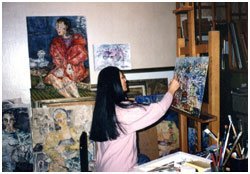
Throughout her life (saying "to live is to produce"), she worked without making any distinction between subjects or techniques (watercolor, oil painting, drawing, gouache); she believed that an artist should master all techniques.
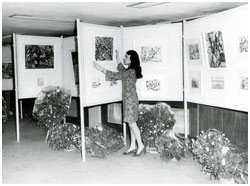
- Exhibitions: She opened her first solo exhibition in 1963 and held a total of 25 solo exhibitions until 2013. She also participated in State Painting and Sculpture exhibitions and many group exhibitions.
- Collections: Her works are held in private/corporate collections domestically and abroad, as well as in State Painting and Sculpture museums.
- Publishing and Awards: She has never participated in any painting competitions. However, she received an "Honorable Mention Award" for her cover designs for Hisar magazine, which featured drawings she painted in a flash as a product of rapid work. At the same time, her drawings and articles were published in Yeni Adam and Hisar magazines, and she penned various stories herself.
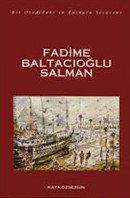
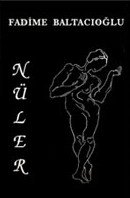
- Written Works About Her: A comprehensive book titled "Fadime Baltacıoğlu Salman" was written by critic Prof. Kaya Özsezgin in 1996. Later, "Fadime Baltacıoğlu" and "Nudes" in 2010, and "Figures" in 2013 were turned into books. Additionally, special programs about her were broadcasted on TRT Radio's external services.
- Memberships: She is one of the founding members of the United Painters and Sculptors Association (BRHD).
She always feared repeating herself and constantly pursued new teachings with an inner sense of responsibility. With her figures where aesthetic integrity flows from head to toe, and her non-sharp but highly meaningful and original lines, she has paved a "Fadime-esque" path in our art of painting; earning an unforgettable place with her technique, will, and creative genius.